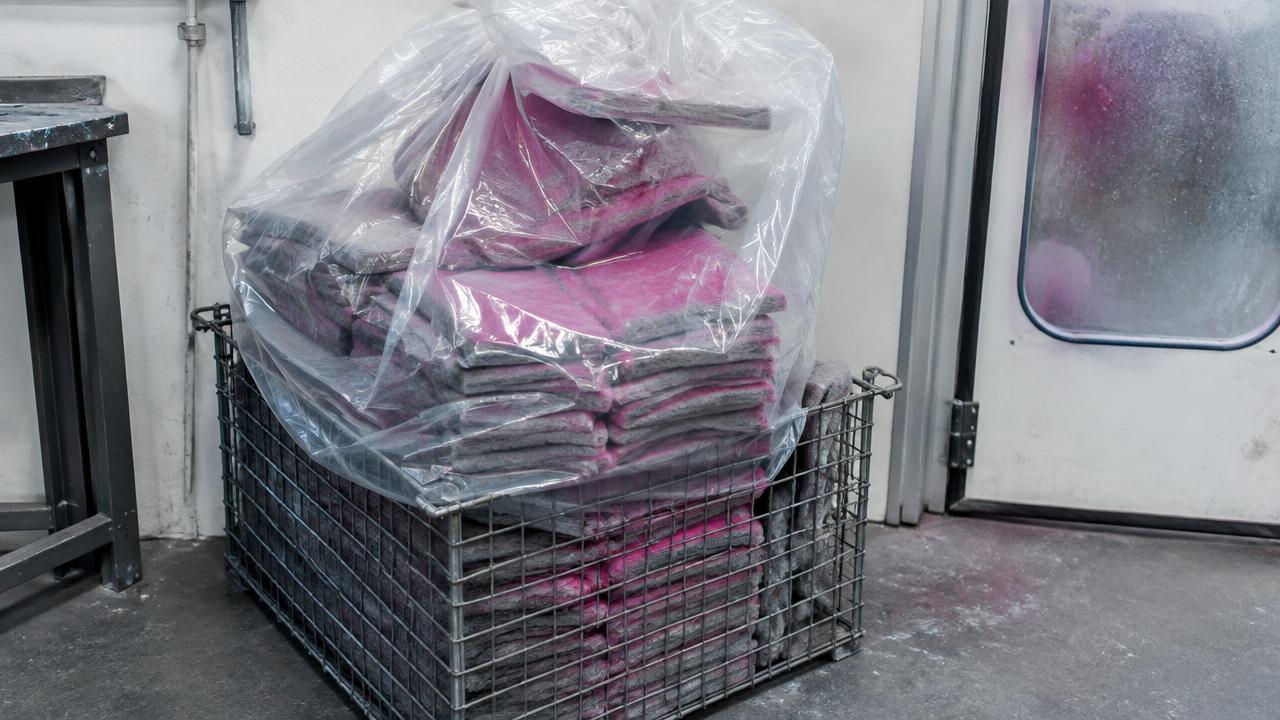
A spray booth change produces more than a bag of fibre pads. The filters carry whatever was sprayed through them: pigment, binder, solvent residue, and in some cases isocyanate-containing coatings, and that composition is what a collection enquiry needs to know, not the filter's shape or size.
This checklist sets out what to record before you call, how to pack filters so they travel safely, and where booth filters stop and other booth waste streams start.
The Filter Stages In A Booth
Most spray booths use filtration at more than one point, and each stage collects a different fraction of overspray.
- Intake filters sit on the air supply side and mainly collect incoming dust rather than paint. Usually the least contaminated filter in the booth.
- Floor or downdraft plenum filters sit beneath the work area and take the bulk of settled overspray as air is drawn down through the booth.
- Exhaust or overdrawn (ceiling/back-wall) filters sit on the extraction side, downstream of the spray zone, and catch the finer overspray before air leaves the booth.
A single change-out can include filters from more than one stage, each carrying a different loading of paint residue. Recording which stage a filter came from helps describe what it is likely to contain.
Why Contamination Matters More Than Shape
Two filters of identical size and material can be very different wastes depending on what passed through them. What was sprayed, and whether the coating system was water based or solvent based, shapes the waste assessment far more than the filter's physical form.
Where isocyanate-containing coatings have been sprayed, that is worth noting separately. The Health and Safety Executive's local exhaust ventilation guidance (HSG258) is written for controlling airborne contaminants at the point of capture, and the same filters doing that job are the ones picking up the residue. Recording the paint system sprayed, rather than just 'booth filters', gives an accurate picture of what is being collected.
Recording A Filter Change
The table below is a simple record to keep next to the booth log, filled in at each change so a collection can be quoted without a site visit.
| Record | Why We Ask | Example |
|---|---|---|
| Filter stage | Exhaust and floor filters usually carry heavier overspray loading than intake filters | Floor plenum filter |
| Paint system sprayed | Different coating chemistries affect how the residue behaves and is assessed | 2K acrylic topcoat |
| Solvent based or water based | Changes storage, segregation and the questions we ask | Solvent based |
| Estimated quantity | Drives container and collection planning | 12 filter panels, approx. 40kg |
| Packaging used | Confirms filters are contained and won't shed fibres or dust in transit | Sealed heavy-duty bags, 2 per crate |
| Storage location and access | Confirms the material is away from ignition sources and reachable for collection | External store, ground floor, roller door access |
Bagging And Storing Filters
Filters are bulky, light, and prone to shedding fibre and dried paint flakes once handled. Bagging or boxing them as soon as they come out of the booth keeps that material contained rather than spread across a yard or vehicle.
- Bag or box filters as they are removed, rather than stacking loose pads for later.
- Use containers that close fully, because an open crate does not stop shedding in transit.
- Keep filters away from heat sources, direct sun and anything that could provide an ignition source, particularly where solvent based coatings have been sprayed.
- Store separately from general waste so the composition of the load stays clear.
- Avoid compacting or crushing loaded filters, which can release trapped solvent or dust.
Filter Changes And Ventilation Performance
How often filters need changing is a ventilation question as much as a waste one. HSE's guidance on local exhaust ventilation (OCM2) notes that filters loaded beyond their design point reduce airflow and capture efficiency, which is part of why booths have a scheduled change interval rather than a change-on-failure approach.
A consistent change schedule also makes the waste side easier to plan: regular, similarly sized batches of filters are simpler to record and book than irregular ones.
Checklist Before You Book
- Filter stage recorded for each batch (intake, floor/plenum, exhaust).
- Paint system and solvent based/water based status noted.
- Quantity estimated in panels or weight.
- Filters bagged or boxed and sealed, not loose.
- Storage location is away from heat and ignition sources.
- Site access for collection confirmed (loading bay, external store, lift access).
- Sludge and wash water logged as separate items, not bundled with filters.
Waste classification for the material you hold follows the Environment Agency's technical guidance (WM3) and should be based on what the filters actually carry, not assumed from the booth type. If you are also clearing contaminated rags, masking paper or overalls from the same booth, see paint contaminated materials disposal for how that stream is handled alongside filters.
Sources
Where The Information In This Guide Comes From
Guidance cited applies to England unless the source states otherwise. Wales, Scotland and Northern Ireland publish their own guidance, and requirements can differ.
- 1.Controlling airborne contaminants at work: a guide to local exhaust ventilation (HSG258) · Health and Safety Executive, Third edition, published 2017
- 2.Local exhaust ventilation (OCM2) · Health and Safety Executive
- 3.Waste classification technical guidance (WM3) · Environment Agency / GOV.UK, Last updated 28 September 2021
- 4.Hazardous waste: segregation and mixing · Environment Agency / GOV.UK, Last updated 1 October 2020
This article is for general information only and does not constitute professional, legal or chemical advice. Waste producers are legally responsible for correctly classifying their waste. For guidance on your specific waste, please contact our team.
Not sure which of these describes what you are holding? Tell us what you have and we will work it out with you.
Request a collection quote