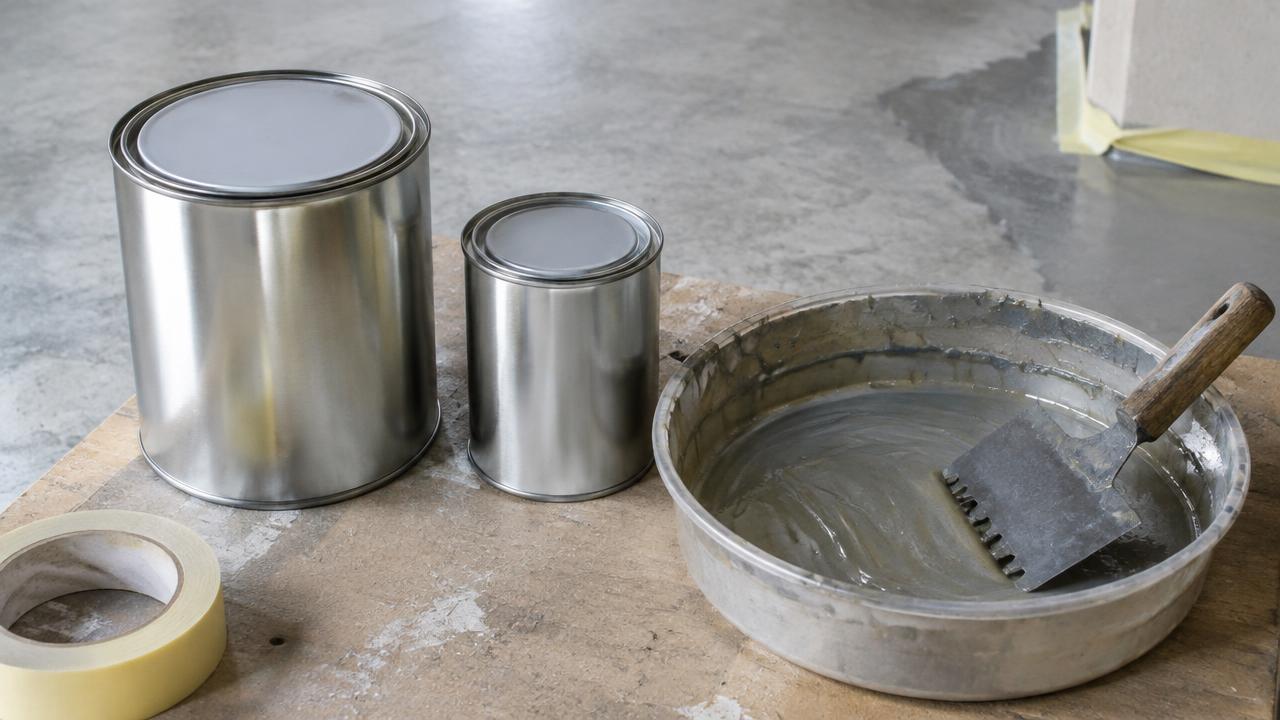
Epoxy coatings are supplied as two components: a resin and a hardener, which are mixed shortly before use and then cure through a chemical reaction. They turn up in floor coatings, protective linings and some specialist paints, and the waste they leave behind needs to be described carefully because resin, hardener, mixed liquid and cured material are not the same thing.
This guide sets out the waste states that commonly arise from epoxy coating work and the information that helps us assess each one.
The Resin And Hardener Reaction
An epoxy coating system is supplied as two separate parts: a resin component and a hardener (or curing agent) component. Combining them in the stated ratio starts a chemical reaction that converts the liquid mixture into a hard, solid film or block. Unlike a one pack paint, this is not a drying process; it happens whether or not the mixture is ever applied to a surface.
Once mixed, the material has a limited working time before it becomes too thick to use, and it will continue curing in the container regardless of what is done with it afterwards.
Why Unused, Mixed And Cured Are Different
Unused resin or hardener still in their original, sound containers are single, known products. Mixed but uncured material is a different, reacting substance. Fully cured material is a solid with a different form entirely, often with little or no free liquid. Each of these needs to be described as what it actually is, not grouped together as 'epoxy waste'.
- Unused components keep their original product identity and documentation.
- Mixed, uncured material is a new combination and should be described by what was mixed and roughly when.
- Gelled material is partway through the reaction: thicker than liquid, not yet solid.
- Cured offcuts or residue are solid and are assessed differently from any liquid component.
Skin Sensitisation And Why Records Matter
Epoxy resin systems are recognised as a cause of skin sensitisation. The Health and Safety Executive's guidance on managing the risks from skin exposure, and its guidance on health surveillance for work involving epoxy resins, both treat epoxy contact as a known occupational health issue, which is part of why knowing exactly which products were used, and in what condition, matters for anyone who may handle the waste afterwards.
Keeping product names, suppliers and container details with the waste, rather than relying on memory once containers are relabelled or combined, reduces the chance of someone handling material without knowing what it is.
Do Not Combine Leftovers To Cure Them
The same applies to combining epoxy waste with other coating or solvent waste streams. The government's guidance on hazardous waste segregation and mixing states that different categories of hazardous waste must not be mixed with each other, and epoxy components are a clear example of why that matters in practice.
How Cured Differs From Uncured
Fully cured epoxy is a solid, generally inert in the sense that it is no longer reacting, but it may still carry pigments, fillers or trace contamination from whatever surface or process it came from. Uncured or partly cured material is still liquid or semi-liquid and reactive, and needs to be handled and described with that in mind.
| Waste state | How it arises | Information we need |
|---|---|---|
| Unused resin | Resin component never mixed, original container | Product name, supplier, quantity, container condition |
| Unused hardener | Hardener component never mixed, original container | Product name, supplier, quantity, container condition |
| Mixed and liquid | Both components combined, still flowing | What was mixed, approximate ratio, how long ago, volume |
| Gelled | Mixed material thickening but not yet solid | Time since mixing, container, approximate volume |
| Cured offcuts | Solid trimmings or test pours from application work | Approximate weight or volume, what surface it came from |
| Cured residue in container | Leftover mixed material that has set in its container | Container type and size, approximate fill before curing |
Putting Together An Enquiry
An enquiry moves faster when each component is described separately rather than lumped together as 'epoxy'. Product names, approximate quantities, container condition and whether anything has been mixed are the details that matter most.
Rags, roller sleeves, gloves and masking used during epoxy application are a related but separate stream, covered on paint-contaminated materials disposal. For the coating itself, start with epoxy coating disposal and describe the waste states above as you find them.
Sources
Where The Information In This Guide Comes From
Guidance cited applies to England unless the source states otherwise. Wales, Scotland and Northern Ireland publish their own guidance, and requirements can differ.
- 1.Health surveillance in the motor vehicle industry · Health and Safety Executive, Last updated 8 May 2025
- 2.Managing the risks from skin exposure · Health and Safety Executive, Published 16 June 2025
- 3.Waste classification technical guidance (WM3) · Environment Agency / GOV.UK, Last updated 28 September 2021
- 4.Hazardous waste: segregation and mixing · Environment Agency / GOV.UK, Last updated 1 October 2020
This article is for general information only and does not constitute professional, legal or chemical advice. Waste producers are legally responsible for correctly classifying their waste. For guidance on your specific waste, please contact our team.
Not sure which of these describes what you are holding? Tell us what you have and we will work it out with you.
Request a collection quote