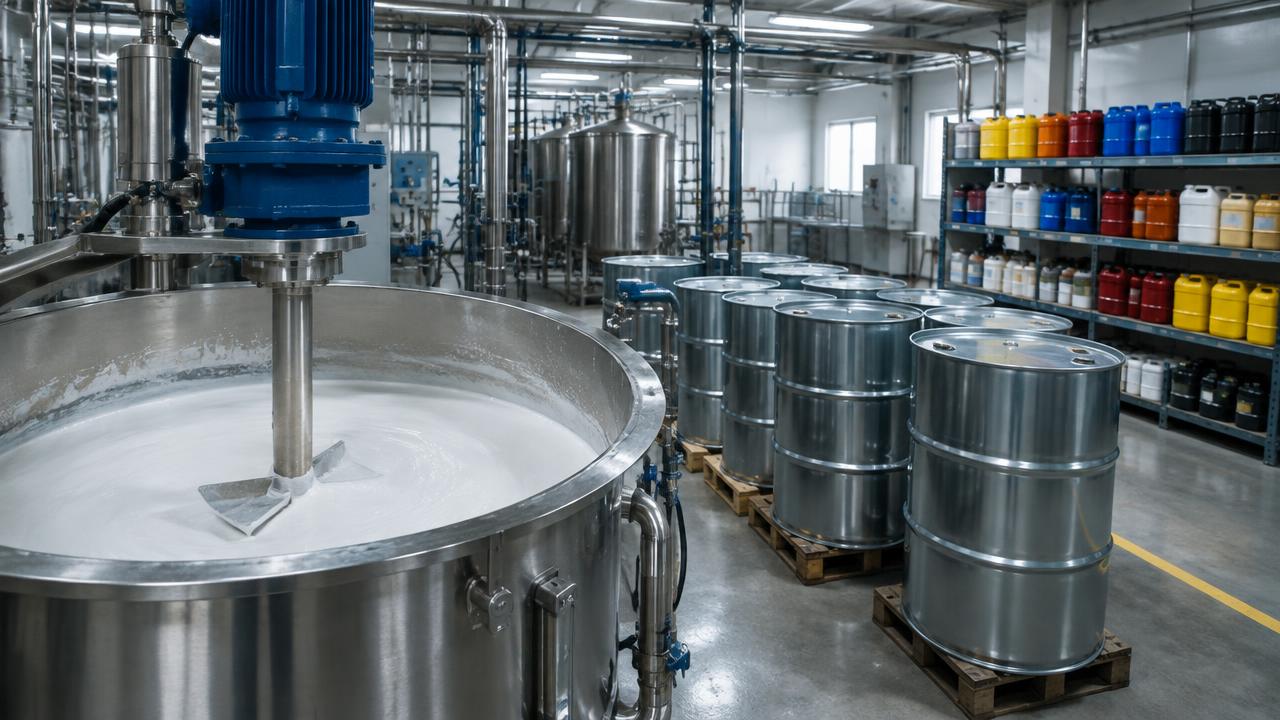
Paint looks simple once it is in the tin: a smooth liquid that goes on in one coat and dries to a flat film. Getting there involves raw material handling, mixing, grinding, adjustment, colour matching and filling, and each of those stages can leave material behind that does not go into a saleable tin.
This guide walks through what paint is made of and how it is made, then sets out where waste typically arises along that route. It is written for anyone trying to understand a production site's waste streams, not as a classification guide.
What Paint Is Made Of
Most paints are built from four constituent groups. Pigments provide colour and hiding power, and they can be mineral, synthetic or metallic depending on the product. Binders, also called resins, form the film that remains once the paint has dried and hold the pigment to the surface. A carrier, either water or organic solvent, keeps the mixture fluid enough to apply and then leaves the film as it dries. Additives are added in small amounts to control properties such as flow, drying speed, skinning resistance or microbial growth.
The FIVA guide to paint raw materials sets out these constituent groups and the role each one plays in a finished coating, and the KFUPM course chapter on paints, pigments and industrial coatings covers the same groups from a formulation perspective, including how pigment and binder choice affects performance.
How Paint Is Made
Production generally follows a sequence, though the detail varies by product type and by manufacturer. Raw materials (pigments, resins, solvents or water, and additives) arrive and are checked in. Pigments are first wetted out and pre-dispersed in part of the binder and carrier to break up clumps. The mixture then goes through milling or grinding equipment to reduce particle size and disperse the pigment evenly.
Once the base is ground to the required fineness, it is let down: diluted with the remaining binder, carrier and additives to the final formulation, and adjusted to match viscosity, colour and other specification targets. Tinting adds colourants to reach a specific shade. The finished batch is then filled into tins, drums or other packaging, labelled and put into stock. Equipment is cleaned between batches, particularly between different colours or product types, to avoid contaminating the next run.
Where Waste Arises By Stage
Waste can be created at almost every stage of that sequence. The table below sets out common waste-generating points against the process stage they belong to.
| Process Stage | What Happens | Waste That Can Arise |
|---|---|---|
| Raw material receipt | Pigments, resins, solvents, water and additives are checked in and stored | Damaged packaging, spilled or out-of-date raw material, rejected deliveries |
| Pre-dispersion and milling | Pigment is wetted out and ground into the binder and carrier | Off-specification base that fails fineness or dispersion checks |
| Let-down and adjustment | The base is diluted and adjusted to final formulation and viscosity | Batches that fail quality control and cannot be corrected |
| Tinting | Colourants are added to reach a specific shade | Mis-tinted batches, flush material from colour changes |
| Filling into packaging | Finished paint is filled into tins or drums and labelled | Spilled or damaged containers, mislabelled stock |
| Cleaning between batches | Tanks, lines and equipment are cleaned, especially between colours or products | Wash-out and changeover residues, cleaning solvent or water |
In addition to these in-process points, waste also arises after a product has reached the market: returned goods that customers send back, obsolete stock that is discontinued or has passed its shelf life, and filter or screen residues removed during routine maintenance of mixing and filling equipment.
Off-Specification And Failed Batches
Not every batch passes quality control first time. A batch can fail on colour match, viscosity, fineness of grind or another specification parameter. Where the fault can be corrected, by further tinting or adjustment for example, the batch may be reworked back into production. Where it cannot be corrected economically, it becomes waste.
- Batches rejected for colour, viscosity or other specification failures
- Flush material generated when lines are changed from one product or colour to another
- Filter and screen residues collected during routine maintenance
- Spilled or damaged packaging that cannot be resold
- Returned goods from customers
- Obsolete or discontinued stock
What Helps When Arranging A Collection
A producer who can describe the batch in front of them gets through an enquiry faster, whether it is a one-off clearance or a recurring collection built around a production schedule.
A Separate Step Is Classification
Knowing where a waste came from in the production process is useful context, but it is not a substitute for classifying it. The Environment Agency's waste classification technical guidance (WM3) sets out the process for assigning the correct waste classification based on composition and hazard, and GOV.UK's guidance on hazardous waste explains the duties that fall on producers and holders of hazardous waste once a material has been classified as such.
If the waste you are dealing with is leftover or surplus product from a production run, surplus paint disposal covers that route. Where the waste is sludge from mixing, filtration or tank cleaning, paint sludge disposal is the more relevant starting point.
Sources
Where The Information In This Guide Comes From
Guidance cited applies to England unless the source states otherwise. Wales, Scotland and Northern Ireland publish their own guidance, and requirements can differ.
- 1.What paint can do, Part 2: paint raw materials · FIVA (European association of the paints, printing inks and adhesives industries)
- 2.Paints, pigments and industrial coatings (constituents of paints) · King Fahd University of Petroleum and Minerals, course chapter
- 3.Waste classification technical guidance (WM3) · Environment Agency / GOV.UK, Last updated 28 September 2021
- 4.Hazardous waste: producers and holders · GOV.UK
This article is for general information only and does not constitute professional, legal or chemical advice. Waste producers are legally responsible for correctly classifying their waste. For guidance on your specific waste, please contact our team.
Not sure which of these describes what you are holding? Tell us what you have and we will work it out with you.
Request a collection quote