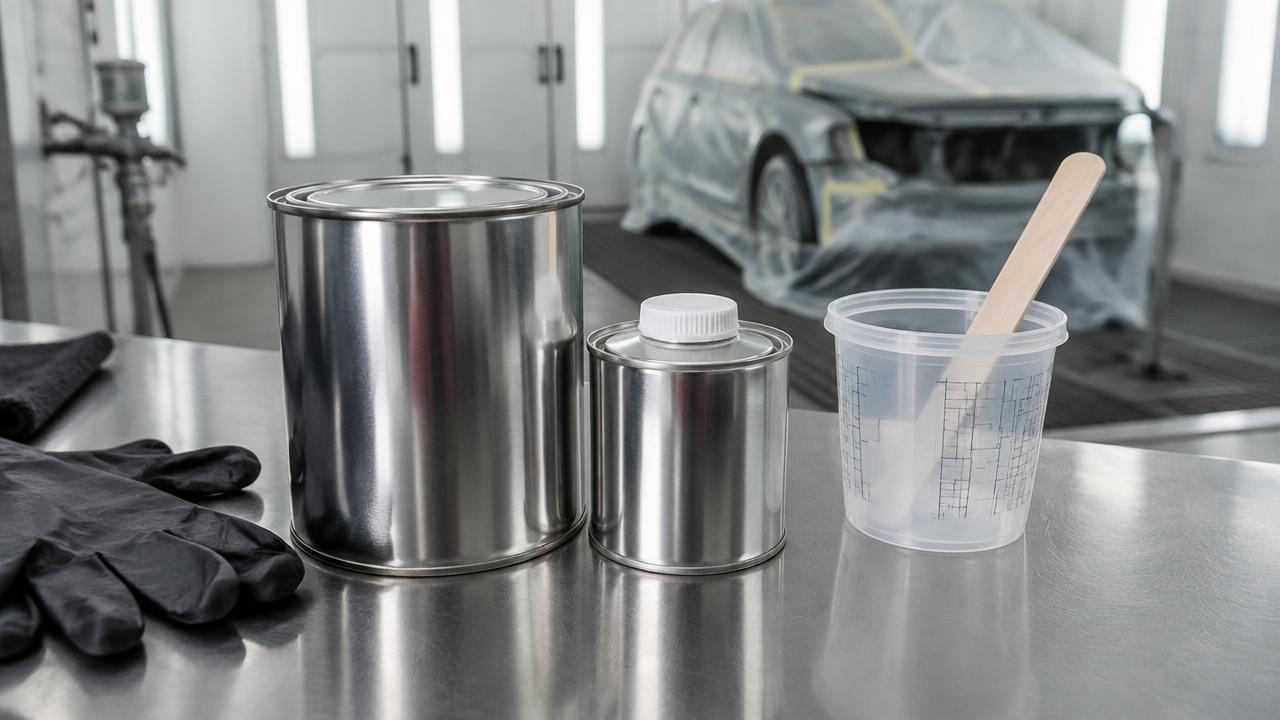
Two pack, or 2K, paints and coatings are supplied as separate components that are mixed shortly before use. They cure through a chemical reaction between the components rather than by the carrier simply evaporating, and that reaction is what makes them useful; it is also what makes the waste different from a single-tin product.
This guide covers what a two pack system is, where isocyanates fit in, and the information that helps us assess unused components and residues correctly.
What A Two Pack System Is
A two pack product is supplied as a base (sometimes called the resin or colour component) and a hardener (sometimes called the activator or curing agent). The two are combined, usually in a stated ratio, immediately before application. Once mixed, the material has a limited working life (a pot life), after which it thickens and then sets, whether or not it has been used.
This is different from a one pack paint, which dries as its carrier evaporates and can in principle be left in a part-used tin indefinitely. A two pack product that has been mixed is on a one-way path to curing regardless of what happens to it next.
Where Isocyanates Come In
Isocyanates are reactive chemicals used in many two pack hardeners, particularly in vehicle refinish products, clearcoats and some industrial coatings. The Health and Safety Executive's guidance on 2-pack isocyanate paints explains that isocyanates are used in some water based paints, most base coats and almost all lacquers used in vehicle refinishing.
Not every two pack product contains isocyanates, because some use other hardener chemistries, so the presence of a second component does not automatically mean isocyanates are involved. The only reliable way to know is the product's own documentation.
Four Different Waste States
Two pack waste is rarely one simple thing. Unused components, mixed-but-uncured material, gelled or partly cured residue, and fully cured material behave differently and need different information for an assessment. Treating them as interchangeable slows things down and risks an unsafe mix-up.
- Unused base or unused hardener: still in their original, separate containers and never combined.
- Mixed and still liquid: components combined but within, or shortly past, their pot life.
- Gelled or partly cured: mixed material that has thickened or set but is not yet a solid, inert mass.
- Fully cured: mixed material that has completed its chemical reaction and is now a solid.
What To Record Per Component
Because the two components of a two pack system can have very different hazard profiles, we ask for details on each one separately rather than for the product as a single entry.
- Product name and, where possible, supplier and part number for both the base and the hardener.
- Whether the components have been mixed, and if so, approximately how long ago.
- Container condition: sealed, opened, damaged or leaking.
- Quantity of each component, and whether that is an estimate or a measured amount.
- Any safety data sheet you hold for either component.
| Waste state | What it is | What to tell us |
|---|---|---|
| Unused base | Colour or resin component, never mixed | Product name, supplier, quantity, container condition |
| Unused hardener | Activator component, never mixed | Product name, supplier, quantity, container condition |
| Mixed and still liquid | Both components combined, within or near pot life | What was mixed, approximate ratio, how long ago, quantity |
| Gelled / partly cured | Mixed material thickening or setting | How long since mixing, container it is in, approximate volume |
| Cured material | Mixed material that has fully reacted and set | Approximate volume or weight, what it is contained in |
| Contaminated rags and masking | Materials wiped or masked with any of the above | Rough quantity, which waste state they were exposed to |
Do Not Combine Or Test On Site
The same caution applies to unlabelled containers found in stores. Rather than opening, mixing or sampling them, record what can be seen from the outside (size, condition, any residual labelling) and raise it as part of the enquiry.
Getting An Assessment Started
Classification of isocyanate-containing and other two pack waste follows the government's waste classification framework, which looks at composition, origin and condition rather than a product's marketing description. The clearer your component-level information, the fewer follow-up questions an assessment needs.
If your site generates general solvent based coating waste alongside two pack materials, the route for that is covered on oil and solvent based paint disposal. Rags, masking and other materials contaminated by any of these products are covered on paint-contaminated materials disposal.
Sources
Where The Information In This Guide Comes From
Guidance cited applies to England unless the source states otherwise. Wales, Scotland and Northern Ireland publish their own guidance, and requirements can differ.
- 1.2-pack isocyanate paints · Health and Safety Executive, Last updated 23 September 2025
- 2.Construction hazardous substances: Isocyanates · Health and Safety Executive
- 3.Safety in isocyanate paint spraying (INDG388) · Health and Safety Executive, Published 2014
- 4.Waste classification technical guidance (WM3) · Environment Agency / GOV.UK, Last updated 28 September 2021
This article is for general information only and does not constitute professional, legal or chemical advice. Waste producers are legally responsible for correctly classifying their waste. For guidance on your specific waste, please contact our team.
Not sure which of these describes what you are holding? Tell us what you have and we will work it out with you.
Request a collection quote