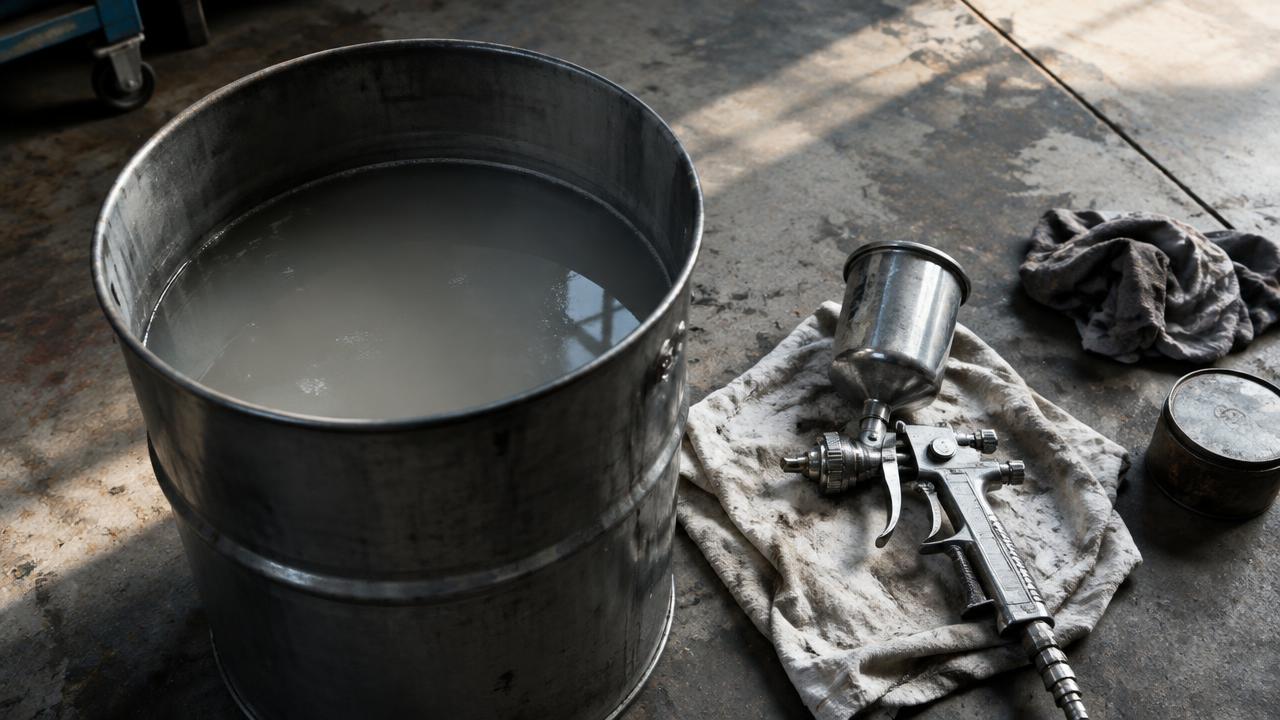
Every spray booth and paint line produces a steady trickle of spent solvent: gun wash from cleaning equipment, flushed-out thinner from colour changes, and solvent-soaked wiping materials. None of it is liquid paint, and treating it as if it were causes avoidable confusion when it comes to storage and collection.
This guide looks at where these wastes come from, how to keep them organised day to day, and what a typical inventory looks like.
Where It Comes From
Gun wash and spent thinner arise from routine equipment care rather than from a single event. Spray guns are flushed between colours and at the end of a shift, lines are cleaned when a production run changes, parts and surfaces are wiped down before and after painting, and booths and mixing areas need periodic cleaning of their own.
Each of these produces a liquid that is mostly solvent but carries some dissolved or suspended paint. That is a different material from paint left in a tin, and a different material again from water based rinse water.
A Different Waste From Paint And Water Based Rinse
It is tempting to pour gun wash into the same container as old paint, on the basis that both are 'paint waste'. They are not interchangeable. Spent solvent has its own composition and hazard profile, and the government's guidance on hazardous waste segregation and mixing is clear that different categories of hazardous waste must not be mixed with each other.
Keeping gun wash, spent thinner and water based wash water in three separate streams, rather than one mixed drum, keeps each one easier to describe and assess.
Storage, Container And Fill Level
- Use containers rated for flammable liquids, kept closed except when adding material.
- Store away from ignition sources, in line with the Health and Safety Executive's guidance on storing flammable liquids in workrooms and similar areas.
- Leave headspace rather than filling a drum completely, and label it clearly as spent thinner or gun wash rather than as paint.
- Keep contaminated rags and wipes in their own separate, closed container rather than dropped into the solvent drum.
A Worked Inventory Example
A small body shop might see something like the pattern below. The figures are illustrative only: every site's build-up rate depends on its throughput and the products it uses.
| Stream | Typical container | How it builds up | What to note |
|---|---|---|---|
| Gun wash | 2 x 25 litre drums | From daily spray gun cleaning, roughly monthly fill | Which solvent is used to clean, approximate fill level |
| Spent thinner | 1 x 200 litre drum | From line flushing and colour changes, roughly quarterly fill | Products flushed through, approximate fill level |
| Contaminated rags | Separate lidded bin | Ongoing from wiping and spill control | Roughly how much accumulates between collections |
Regular exchange, which means swapping a fuller container for an empty one on a set schedule rather than waiting for a drum to overflow, keeps the storage area tidy and makes each collection a known quantity rather than a surprise.
Transport Is Assessed Per Load
Waste classification and transport classification are separate questions. Classifying the waste tells you what it is; moving it on the road is governed by its own rules, and the Department for Transport's guidance on moving dangerous goods sets out how those are worked out for a specific consignment. No single UN number, packing group or transport rule applies to all solvent waste; it depends on the actual composition and quantity of the load being moved.
That is one more reason to keep streams separated and documented: a known, single-stream drum of gun wash is far easier to assess for transport than a mixed and undocumented one.
Booking A Collection
For an enquiry, the details above (what each stream is, roughly how much there is, what it is stored in and how full the containers are) are the starting point. The waste classification framework in WM3 is then applied to the actual composition of what you hold, not to a generic description of 'solvent waste'.
For the solvent and thinner itself, see paint thinners and solvents disposal. Where the same site also generates solvent based paint waste, that is covered on oil and solvent based paint disposal.
Sources
Where The Information In This Guide Comes From
Guidance cited applies to England unless the source states otherwise. Wales, Scotland and Northern Ireland publish their own guidance, and requirements can differ.
- 1.Hazardous waste: segregation and mixing · Environment Agency / GOV.UK, Last updated 1 October 2020
- 2.Storage of flammable liquids in process areas, workrooms, laboratories and similar working areas · Health and Safety Executive
- 3.Moving dangerous goods · Department for Transport / GOV.UK
- 4.Waste classification technical guidance (WM3) · Environment Agency / GOV.UK, Last updated 28 September 2021
This article is for general information only and does not constitute professional, legal or chemical advice. Waste producers are legally responsible for correctly classifying their waste. For guidance on your specific waste, please contact our team.
Not sure which of these describes what you are holding? Tell us what you have and we will work it out with you.
Request a collection quote