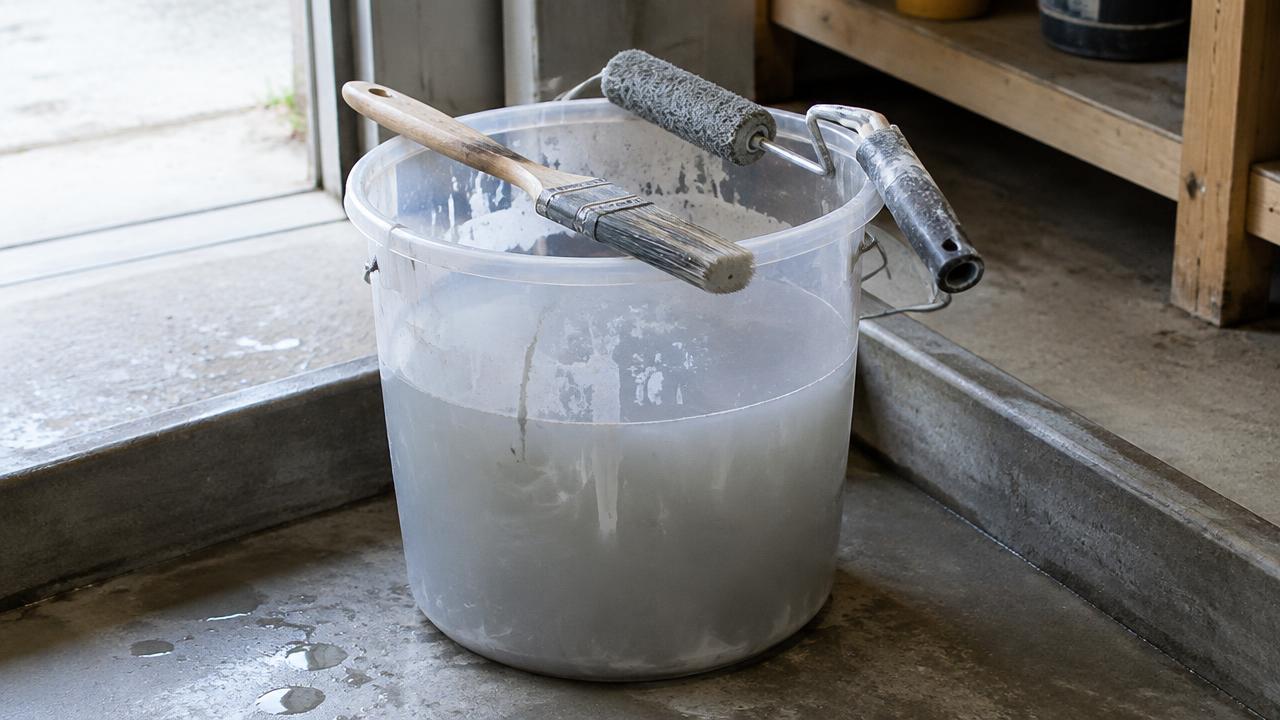
Almost every site that applies paint also generates wash water, from rinsing brushes, flushing spray lines, washing down a booth, or cleaning up after a spill. It looks like dirty water, but it carries paint solids and sometimes solvent, and that changes what you are allowed to do with it.
This guide maps where wash water typically comes from, why it cannot simply go down a drain, and what we ask before a collection can be arranged.
Where Wash Water Comes From
Wash water on a paint-handling site usually comes from one of a small number of recurring activities.
| Source | How It Is Generated | What To Note |
|---|---|---|
| Hand tool washout | Rinsing brushes and rollers in a sink, bucket or wash station | Water based or solvent based paint; frequency and volume |
| Spray equipment flushing | Flushing guns, pots and lines between colours or at end of shift | Solvent or water flush; whether cleaning agents are added |
| Booth water wash | Water-wash booth systems that capture overspray in a water curtain | Continuous or batch system; chemical additives used in the wash system |
| Tank and line cleaning | Cleaning mixing tanks, feed lines or pumps between batches | Residue carried over from the previous product run |
| Spill washdown | Hosing down a spill area after containment and initial clean-up | What was spilled; whether any absorbent material was also used |
Why It Cannot Go To Drain
Paint wash water must not be discharged to a surface water drain, watercourse or directly to ground. The Environment Agency's guidance on discharges to surface water and groundwater sets out that such discharges generally require an environmental permit, and discharging without one is an offence.
Discharging to the foul sewer is a different route, and it is not automatically allowed either: it normally needs a trade effluent consent from the sewerage undertaker, as described in GOV.UK's guidance on discharging effluent or waste water. Without that consent in place for the specific waste stream, wash water should be contained and collected rather than tipped to any drain.
How Wash Water Differs From Sludge And Liquid Paint
Wash water, booth sludge and leftover liquid paint are three different materials, even though they can come from the same area of a site.
- Liquid paint is the product itself, still largely at its original concentration; see water based paint disposal for surplus or unused paint.
- Sludge is settled or scraped solids, thicker than water and often semi-solid, and it is handled through paint sludge disposal.
- Wash water is the diluted, mostly liquid run-off from cleaning, which is the subject of this guide.
Keeping these three separate in your own storage mirrors how they are assessed and collected. Mixing them together, for example by tipping scraped sludge into a wash water drum, makes the combined material harder to classify, not easier.
What To Record
Before a collection enquiry, it helps to have the following to hand:
- Approximate volume, by drum count or litres.
- Whether the paint involved was water based, solvent based, or a mix of both over time.
- Whether any solvent, thinner or paint stripper has gone into the same wash water.
- The container the water is currently held in, and whether it is compatible with the contents.
- Where the containers are stored on site, including whether the area is bunded.
This matches the same level of detail used for other paint waste streams: the Environment Agency's waste classification technical guidance (WM3) is the framework used to classify the material you hold, based on its actual composition rather than its source alone.
Containers And Storage
Wash water should be kept in closed, compatible containers, clearly marked, and away from any drain or gulley. Where solvent has been part of the mix, the same precautions that apply to solvent storage (away from ignition sources, in a bunded area) apply here too.
If you need containers specifically for wash water, or want to set up a regular exchange so drums are swapped rather than refilled from scratch each time, that is arranged through containers and exchange.
What Happens After Collection
The route a given batch of wash water takes, and whether any part of it can be reused, recovered or must be disposed of, is confirmed after assessment of the specific material, not assumed in advance. Reuse, recovery and disposal are different outcomes, and which one applies depends on composition, not on how the water looks.
If your wash water routinely contains solvent from gun flushing or line cleaning, it's worth noting that alongside any paint type when you make an enquiry, since it affects how the material is handled from the point of collection onward.
Sources
Where The Information In This Guide Comes From
Guidance cited applies to England unless the source states otherwise. Wales, Scotland and Northern Ireland publish their own guidance, and requirements can differ.
- 1.Discharges to surface water and groundwater: environmental permits · Environment Agency / GOV.UK, Last updated 20 April 2026
- 2.Discharging effluent or waste water (England) · GOV.UK
- 3.Washing water-based paint containers before they are reused or recovered (LRWP 30) · Environment Agency / GOV.UK, Published 20 August 2019
- 4.Waste classification technical guidance (WM3) · Environment Agency / GOV.UK, Last updated 28 September 2021
This article is for general information only and does not constitute professional, legal or chemical advice. Waste producers are legally responsible for correctly classifying their waste. For guidance on your specific waste, please contact our team.
Not sure which of these describes what you are holding? Tell us what you have and we will work it out with you.
Request a collection quote