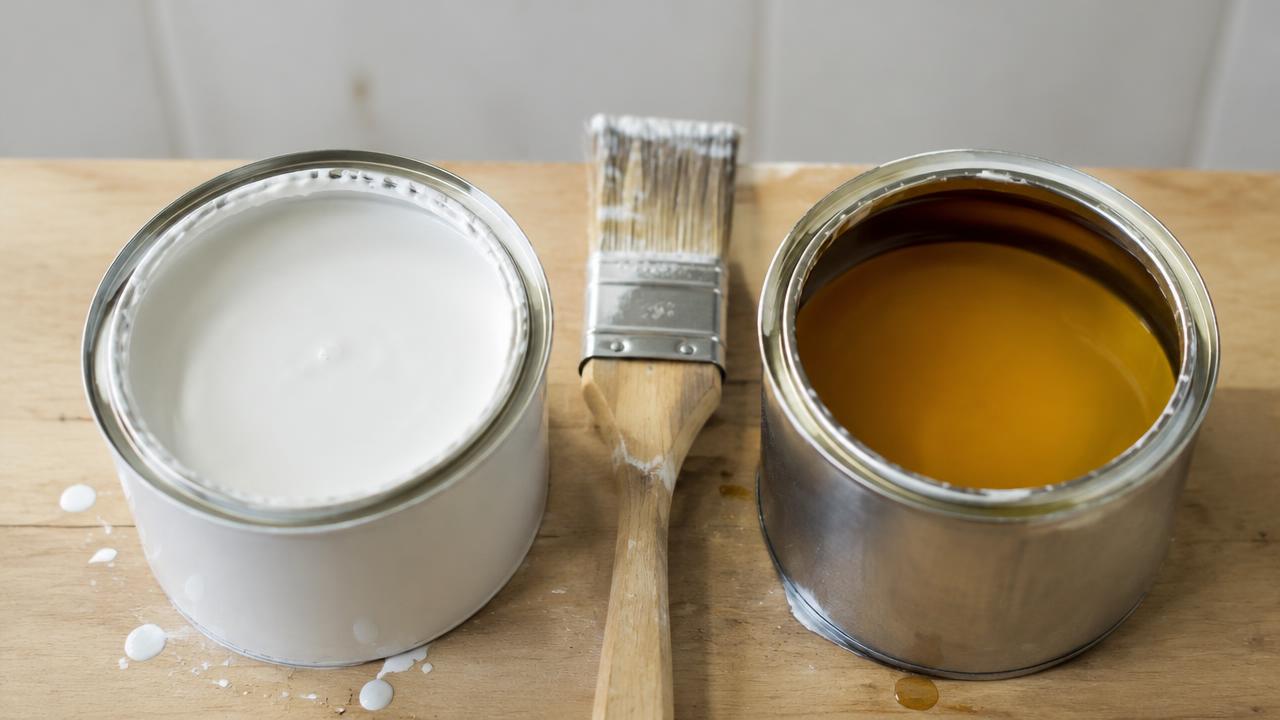
Almost every paint is the same idea: colour and binder carried in something liquid so it can be spread thin, then left behind as that liquid leaves. What changes between products is the carrier: water in one, organic solvents in the other, and that single difference runs through storage, transport, treatment and the paperwork a collection needs.
This guide sets out the differences you can actually see on site, and the questions they raise when the material becomes waste.
What The Carrier Does
A paint has four working parts: pigment for colour and hiding, binder (resin) for the film that stays on the wall or panel, a carrier that makes the mix fluid enough to apply, and additives for things like flow, skin resistance or drying speed. The carrier is the part that evaporates first, and it is the part that decides most of what happens next.
In a water based paint the carrier is mostly water, with a small share of co-solvents such as glycol ethers to help the film form. In a solvent based paint the carrier is a mix of organic solvents, such as white spirit and similar hydrocarbons in a traditional gloss, or stronger solvents in industrial products. The binder is different too: acrylic and vinyl emulsions in the water based can, alkyds and other resin systems in the solvent based.
That is why the two behave so differently on a job. Water based paints clean off tools with water, dry quickly and carry less solvent smell. Solvent based paints stay workable longer, level out more slowly and need solvent to clean. Once the tin is finished, both end up as a residual material that has to be classified and moved, and the carrier is a large part of what the waste is.
How To Tell Which You Have
Where the product is still identifiable, the label and the safety data sheet should settle it. Where the tin is unlabelled or the contents have changed, you are working from evidence rather than a name on a can.
- Product name and description on the label: emulsion, acrylic and latex descriptions usually point to water based; gloss, undercoat, solvent based and 2K point elsewhere.
- Cleaning instructions: if the tin says clean with water, that is a strong sign; if it says clean with white spirit or thinners, it is not.
- The safety data sheet, particularly Section 3 (composition) and Section 9 (physical and chemical properties), which list the solvents present.
- Condition of the material: a skin, a set residue and a wet liquid are three different waste states, not one.
- How the waste was created: a leftover from a job, a wash-out, a spillage soaked up, or a batch taken out of production.
Where The Two Differ As Waste
The table below sets out the practical differences we see in enquiries. It describes what usually changes, not a rule that applies to every product.
| Question | Water Based | Solvent Based |
|---|---|---|
| What drives the assessment | Binder system, additives and anything mixed in | Solvent content and flash point, plus the binder |
| Cleaning and residues | Brush and roller wash water, rinse-out water | Gun wash, spent thinners, solvent rinse-out |
| Storage on site | Closed containers, protected from freezing | Closed, compatible containers away from ignition sources |
| Segregation | Keep separate from solvent based material and wash water | Keep separate from water based material and wash water |
| What we ask for | Product name, quantity, container condition, contamination | Product name or safety data sheet, quantity, container condition, flash point if known |
| Common mix-up to avoid | Tins returned to a general waste stream | Solvent waste combined with paint or water based waste |
Neither column is a classification. A water based paint can carry hazardous ingredients, and a water based waste that has been contaminated with solvent or another substance is a different material from the one that left the tin. Classification of the waste in your possession is a separate step, and the framework for it is set out in the government's waste classification guidance.
Water Based Is Not The Same As Isocyanate-Free
This one catches sites out. The Health and Safety Executive states plainly that 'water-based' does not mean 'isocyanate-free': it means the product is emulsion based with reduced solvent levels, and isocyanates are used in some water based paints, most base coats and almost all lacquers.
So the carrier tells you how to store, clean and segregate. It does not tell you what the material contains, and it does not tell you the exposure risks for the people handling it. For that you need the product information for the specific item, and for two pack and reactive systems a separate assessment of each component.
Keeping The Two Apart
Segregation is the single most useful thing a site can do before a collection, and it is also a legal duty: the government's guidance on hazardous waste states that hazardous waste must not be mixed with non-hazardous waste, that different categories of hazardous waste must not be mixed with each other, and that waste oils with different characteristics must not be mixed.
- Keep water based and solvent based material in separate, clearly marked containers.
- Keep wash water and gun wash away from both, because they are their own waste streams.
- Do not top one container up with a different waste to save space.
- Keep lids on. A container that has been sitting open changes: water based material skins over, solvent based material thickens, and both become harder to describe.
- Note what went in. A container of mixed leftovers is an assessment enquiry, not something to book as a single waste type.
Before You Book A Collection
For either type, the enquiry goes more smoothly when you can describe the same five things: what the material is, roughly how much of it there is, what it is sitting in, how full those containers are, and where the collection happens. Photos of labels and any safety data sheets you hold close most of the remaining questions.
If your waste is mostly water based material in tins, start with water based paint disposal. If it is solvent based coatings, or a mixture you cannot separate, the route is described on oil and solvent based paint disposal. Mixed or unidentified waste is an assessment enquiry rather than a dead end, so tell us what you have and what you know about it.
Sources
Where The Information In This Guide Comes From
Guidance cited applies to England unless the source states otherwise. Wales, Scotland and Northern Ireland publish their own guidance, and requirements can differ.
- 1.Waste classification technical guidance (WM3) · Environment Agency / GOV.UK, Last updated 28 September 2021
- 2.Hazardous waste: segregation and mixing · Environment Agency / GOV.UK, Last updated 1 October 2020
- 3.2-pack isocyanate paints · Health and Safety Executive, Last updated 23 September 2025
- 4.PaintCare: creating a circular economy for leftover decorative paint · PaintCare UK / British Coatings Federation, Checked 12 October 2026
This article is for general information only and does not constitute professional, legal or chemical advice. Waste producers are legally responsible for correctly classifying their waste. For guidance on your specific waste, please contact our team.
Not sure which of these describes what you are holding? Tell us what you have and we will work it out with you.
Request a collection quote