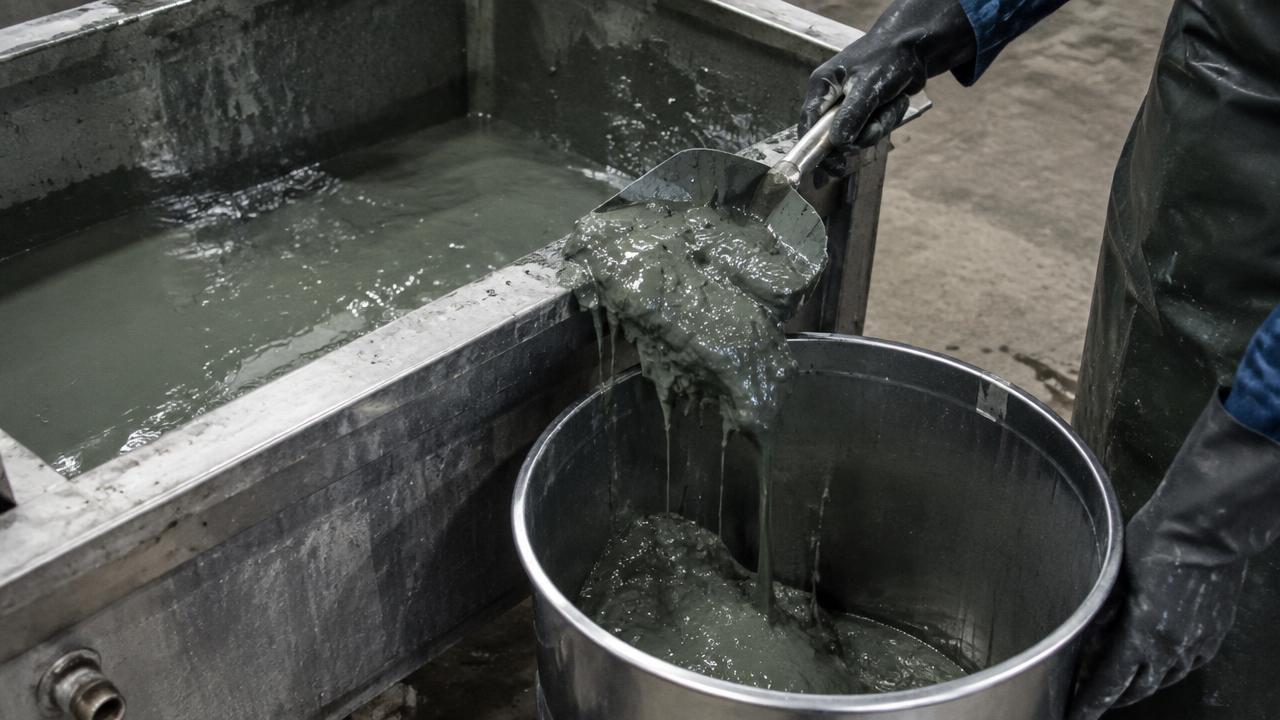
Paint sludge is what is left once overspray, wash water and settled solids have separated from the liquid they started in. It builds up quietly in booths, tanks and wash systems, and because it looks and behaves differently depending on where it came from, a single description of 'sludge' rarely covers what an assessment needs.
This guide sets out where sludge typically forms, what changes the questions an enquiry asks, and why it should be kept apart from other waste streams.
Where Sludge Forms
Sludge forms wherever paint is deliberately swept out of a process, or settles out on its own. Spray booth water wash systems capture overspray in a water curtain, and the paint solids gradually separate out and collect at the bottom. Wash-down tanks used to clean equipment build up a similar layer over time. Filter systems on booths and lines collect solids as a cake rather than a liquid.
- Spray booth water wash tanks and sumps
- Wash-down tank bottoms from equipment or parts cleaning
- Residue scraped or rinsed from mixing and application equipment
- Spill absorbents used on wet paint or sludge
- Filter cake from booth or line filtration
Wet Sludge, Dewatered Cake And Dried Residue
Not all sludge is the same consistency. Wet settled sludge sitting under a layer of wash water is mostly liquid with suspended solids. Dewatered cake has had much of the free water removed, often by a filter press or similar process, and behaves more like a damp solid. Dried residue has lost most of its moisture through standing or exposure and can be closer to a crumbly solid.
Each of these needs describing as what it actually is on the day of enquiry, since the water content changes both the volume involved and the handling needed.
What Changes The Questions
Water content, consistency, any contaminants mixed in, and the type of container it sits in all affect what an assessment needs to know. Sludge contaminated with other chemicals used in the same process (detergents, corrosion inhibitors, solvent rinse) is a different material from straightforward paint solids and water.
- Approximate water content: does it pour, scoop or need digging out?
- Anything else known to be in the system, such as additives, cleaning chemicals or other coatings
- What it is currently held in, such as an open tank, closed drum or lined skip
- How much there is and how often it is removed from the process
Why Photos And Process Detail Help
A photo of the sludge in place, along with a short description of the process that produced it, tells an assessor more in a minute than a written description can on its own. Knowing whether sludge came from a water wash booth, a parts-cleaning tank or a filter press immediately narrows down what is likely to be present and how it should be handled.
This matters because paint sludge classification follows the government's waste classification technical guidance (WM3), which looks at the actual composition and origin of the material rather than treating 'paint sludge' as a single, fixed waste code.
Keep Sludge Separate From Other Streams
Sludge should not be combined with liquid paint waste, solvent waste or general wash water. The guidance on hazardous waste segregation and mixing applies here as much as anywhere: mixing streams together to save space or simplify storage removes information and can turn a straightforward waste into a harder one to classify.
| Where it arises | What it usually looks like | What to record |
|---|---|---|
| Spray booth water wash | Grey or coloured sludge under a layer of wash water | Approximate volume, how often the tank is cleaned out |
| Wash-down tank bottoms | Settled layer at the base of a cleaning tank | Tank size, depth of sludge, what was being cleaned |
| Equipment cleaning | Loose residue scraped or rinsed from tools and lines | What equipment it came from, approximate quantity |
| Spill absorbents | Absorbent granules or pads soaked with paint or sludge | What was spilled, approximate quantity of absorbent used |
| Filter cake | Damp to dry solid cake removed from a filter | Which filtration system, approximate weight or volume |
What Not To Do On Site
Arranging An Assessment
The information in the table above, together with a photo and a short note on the process involved, is usually enough to start an assessment. Outcomes for sludge vary by composition, because some routes lead to disposal and others to treatment or recovery, and which applies is confirmed after that assessment rather than assumed in advance.
Start with paint sludge disposal for the sludge itself. Where the same process also produces significant volumes of wash water rather than settled solids, that is covered separately on paint wash water disposal.
Sources
Where The Information In This Guide Comes From
Guidance cited applies to England unless the source states otherwise. Wales, Scotland and Northern Ireland publish their own guidance, and requirements can differ.
- 1.Waste classification technical guidance (WM3) · Environment Agency / GOV.UK, Last updated 28 September 2021
- 2.Hazardous waste: segregation and mixing · Environment Agency / GOV.UK, Last updated 1 October 2020
- 3.Hazardous waste: producers and holders · GOV.UK
This article is for general information only and does not constitute professional, legal or chemical advice. Waste producers are legally responsible for correctly classifying their waste. For guidance on your specific waste, please contact our team.
Not sure which of these describes what you are holding? Tell us what you have and we will work it out with you.
Request a collection quote